
The $500 Billion Data Center Revolution: Why AI Infrastructure Spending Dwarfs Traditional Tech Investment
The numbers sound almost fictional. Eight major hyperscale companies are planning to spend $371 billion on AI data centers and computing resources in 2025 alone—a 44% increase from 2024
11/29/20255 min read
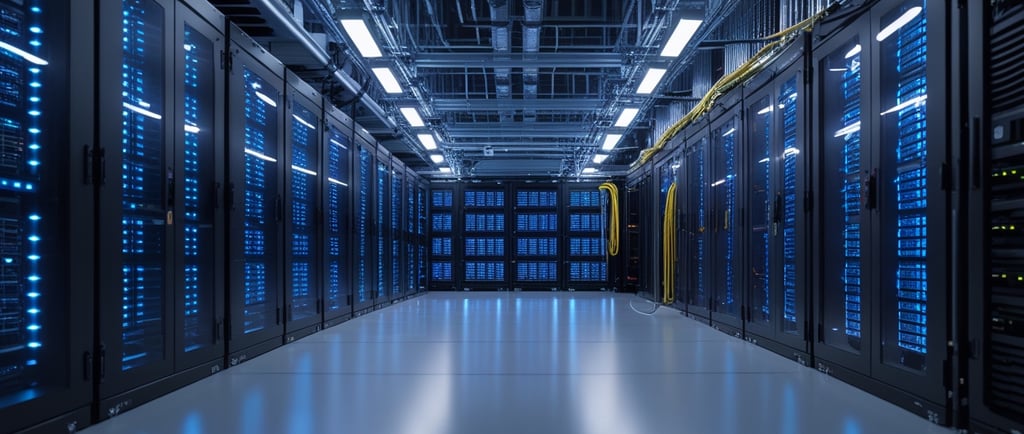
The numbers sound almost fictional. Eight major hyperscale companies are planning to spend $371 billion on AI data centers and computing resources in 2025 alone—a 44% increase from 2024. McKinsey projects the total could reach $5.2 trillion by 2030 under moderate growth scenarios, with aggressive forecasts pushing that figure to nearly $8 trillion. To put this in perspective, these data center investments dwarf the entire annual infrastructure spending of most developed nations.
This isn't just another tech bubble or hype cycle. Eight hyperscalers expect capital expenditures to reach half a trillion dollars annually by the early 2030s, fundamentally reshaping how capital flows through global markets. Understanding why this massive spending wave is happening—and what constraints might limit it—matters for anyone trying to navigate investment opportunities over the next decade.
Why Data Centers Suddenly Demand Unprecedented Capital
The explosion in AI infrastructure spending stems from a simple but profound shift: in 2024, capital-light hyperscalers surpassed capital-intensive utilities in capital expenditures. Companies that built empires on software and services with minimal physical assets are now spending more on infrastructure than organizations whose entire business model revolves around building power plants and transmission lines.
AI workloads consume exponentially more power than traditional computing. About 60% of electricity used by data centers powers the servers, with AI-optimized chips consuming two to four times as many watts as traditional counterparts. This isn't marginal efficiency loss—it's a fundamental change in computing economics that forces massive infrastructure buildouts.
The scale becomes clearer when examining specific commitments. Anthropic announced $50 billion for American computing infrastructure, building custom data centers in Texas and New York. OpenAI, Oracle, and SoftBank's Stargate project aims to invest $500 billion with 10 gigawatts of capacity. Amazon pledged up to $50 billion on AI infrastructure specifically for U.S. government agencies.
These aren't speculative announcements. Anthropic's project will create approximately 800 permanent jobs and 2,400 construction jobs, with sites coming online throughout 2026. Real construction, real hiring, real capital deployment.
The Power Crisis Nobody Saw Coming
Here's where the story gets complicated. Data centers need electricity—enormous amounts of it—and the power infrastructure to deliver that electricity doesn't exist at the scale required. Goldman Sachs Research forecasts global power demand from data centers will increase 50% by 2027 and by as much as 165% by the end of the decade compared to 2023 levels.
Globally, AI data centers could need 10 gigawatts of additional power capacity in 2025, growing to 68 gigawatts by 2027—close to California's total power capacity. Training could demand up to 1 gigawatt in a single location by 2028 and 8 gigawatts by 2030—equivalent to eight nuclear reactors powering a single data center.
The challenge isn't generating power—it's transmission and distribution. The bottleneck isn't necessarily with power generation itself, but rather the intricate web of power transmission and distribution. You can build all the solar panels and wind turbines you want, but if the grid can't deliver that electricity where data centers need it, the power is useless.
In 2023, data centers consumed about 26% of total electricity supply in Virginia and significant shares in North Dakota (15%), Nebraska (12%), Iowa (11%), and Oregon (11%). These concentrations create strain on local grids that weren't designed for such concentrated demand.
The Investment Winners and Losers
This infrastructure buildout creates clear winners across multiple sectors, though not always in obvious ways.
Hyperscalers are committing staggering amounts. Microsoft allocated $80 billion in 2025 for AI data centers, Amazon pledged $100 billion, Alphabet committed $75 billion, and Meta plans to spend up to $65 billion. These aren't aspirational numbers—they're committed capital expenditures flowing through supply chains right now.
CoreWeave debuted on Nasdaq in March at a $23 billion valuation, making it the biggest US tech IPO in two years, with stock up nearly 90% since IPO. The company currently operates more than 33 data centers in the US and Europe, renting out more than 250,000 GPUs.
Utilities face massive upgrade requirements. Electric and gas utility capital expenditures are expected to surpass $1 trillion cumulatively within the next five years for the 47 biggest investor-owned utilities. But utilities face a fundamental problem: in the PJM electricity market stretching from Illinois to North Carolina, data centers accounted for an estimated $9.3 billion price increase in the 2025-26 capacity market, with average residential bills expected to rise by $18 monthly in western Maryland and $16 monthly in Ohio.
Residential customers are paying for infrastructure upgrades that primarily benefit tech companies. This creates political tensions that could constrain future buildouts regardless of available capital.
Power generation equipment is sold out. Natural gas turbines are largely sold out through the end of the decade, and advanced nuclear power technologies are not expected to reach commercial scale until the 2030s at the earliest. Even if you have billions to spend, you can't buy equipment that doesn't exist.
The Bubble Question: Is Demand Real?
Willie Phillips, who served as chairman of the Federal Energy Regulatory Commission from 2023 until April 2025, stated there is a question about whether all the projections are real, noting some regions have projected huge increases and then readjusted those back.
The concern is legitimate. The AI companies are shopping the same big projects around to multiple utilities as they look for the quickest access to power, with similar projects that look exactly the same being requested in different regions across the country.
This creates risk of utilities overbuilding. Utilities spent $178 billion on grid upgrades last year and are forecasting $1.1 trillion in capital investments through 2029. If AI demand doesn't materialize as projected, ratepayers and utility shareholders bear the cost of stranded assets.
Yet efficiency improvements may not solve the problem. While DeepSeek reported reducing training costs by approximately 18 times and inferencing costs by about 36 times compared with GPT-4o, preliminary analysis suggests efficiency gains will likely be offset by increased experimentation and training across the broader AI market.
This aligns with Jevons Paradox—when technology makes resource use more efficient, total consumption often increases rather than decreases because the improved efficiency makes the technology more economically viable for more applications.
Investment Implications Beyond the Obvious
The data center buildout creates opportunities that extend beyond obvious plays like real estate investment trusts or construction companies.
Cooling technology becomes critical. Power density in data centers is growing from 162 kilowatts per square foot to 176 kilowatts per square foot in 2027. Traditional air cooling can't handle these densities. The global liquid cooling market is expected to reach $17.8 billion by 2027, with intelligent cooling technologies powered by AI potentially cutting energy consumption by 30%.
Grid modernization investment accelerates. The transmission and distribution infrastructure needs updating regardless of data center demand, but AI is forcing utilities to compress decades of planned upgrades into years. Companies providing grid management software, transformer manufacturing, and power electronics benefit from this accelerated timeline.
Geographic arbitrage opportunities emerge. Secondary markets like Columbus, Ohio, are attracting $2.3 billion in data center investments. Industry estimates suggest roughly $170 billion of data center asset value will require new construction lending or permanent financing in 2025 alone.
Real estate and lending opportunities exist in markets that combine available power, reasonable land costs, and proximity to fiber optic networks—not just traditional tech hubs.
The Knowledge Advantage in Infrastructure Investing
Most retail investors lack frameworks for evaluating infrastructure investment opportunities of this scale. Understanding how power markets work, what constraints actually bind capacity expansion, and which technologies solve critical bottlenecks separates those who identify opportunities from those who chase headlines after valuations have already expanded.
The AI data center market is growing at 28.3% annually, far outpacing traditional data centers, with approximately 33% of global data center capacity dedicated to AI by 2025, expected to reach 70% by 2030. But growth rates alone don't tell you which specific companies or sectors capture value.
Quality investment education covering infrastructure economics, power market dynamics, technology adoption patterns, and supply chain analysis creates the foundation for evaluating these opportunities effectively. The investors building wealth through this infrastructure wave aren't speculating on trends—they understand the specific constraints, bottlenecks, and solutions that determine which participants profit.
Whether evaluating data center REITs, utility companies, equipment manufacturers, or technology providers, comprehensive understanding of infrastructure investment fundamentals creates advantages that compound throughout your investing career.